


Pests
Identify a Pest
Identifying a pest can be difficult. Use this page to help you identify a pest.
This page can help you identify many of the common pests, their physical attributes and issues. Of course, if you can’t identify a pest – give us a call!
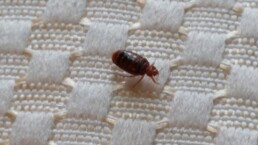
Identify a Pest - Bedbugs
Bed bugs are nocturnal blood-feeding pests of humans are oval shaped reddish brown insects, 1 – 5 mm (1/16 inches to 3/16 inches) long.
Identify a Pest - Ants
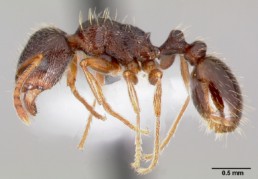
Pavement Ants
An introduced pest from Europe, Pavement ants are 2-4 millimeters long and range from dark brown to black in colour.
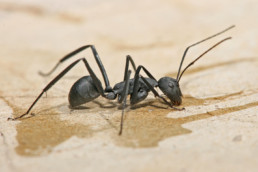
Carpenter Ants
Nesting inside our structures, Carpenter ants are large black ants with polymorphic (varying sized) workers. One species in southern Ontario is black with a red thorax. Workers range from 6 – 12 mm and winged swarmers up to 18mm. Queens are rarely seen and can be as large as 20mm long.

Pharaoh Ants
Tiny and almost translucent, Pharaoh ants are yellow or reddish-brown in colour and are very small (2 mm in length).
Identify a Pest - Cockroaches
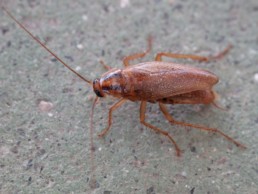
German Cockroach
The German cockroach is brown with two black horizontal stripes on their pronotum (the shield-like structure partially covering the insects head and thorax) from behind their head to the base of their wings. They are 11 mm to 16 mm in size (adults are ½ inches to 5/8 inches long). Adults are winged. Immature cockroaches do not have wings and are light brown with varying dark brown markings.
Identify a Pest - Fleas
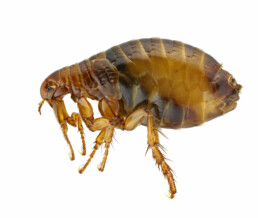
Flea
Mainly pests of pets, Fleas will also take a bite out of humans. Adults are 1 to 4 mm long and are black to reddish-brown in colour. They are flattened laterally to pass easily through the fur of animals.
Identify a Pest - Bees and Wasps
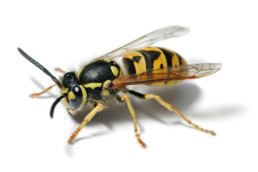
Yellow Jackets
There are 3 species in Southern Ontario with black and yellow bands on a smooth abdomen. Quite often confused with honeybees which are thicker insects with hairy bodies. Yellow jackets are typically 12mm in length.
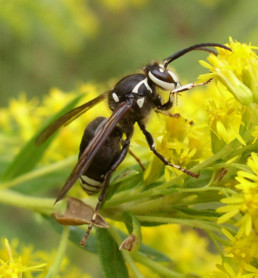
Bald Faced Hornet
With a very painful sting, Bald Faced Hornets are 13 to 20mm and black with white or bluish markings.
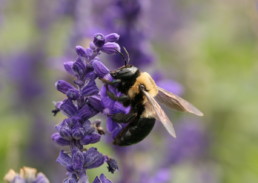
Carpenter Bee
Carpenter bees are thick and robust with a shiny abdomen. They are black or mainly black with yellow or white markings. Commonly confused with Bumble bees which are hairy with larger yellow markings.
Identify a Pest - Pantry Pests
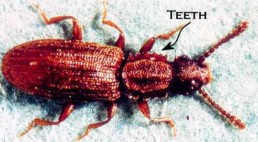
Sawtoothed Grain Beetles
A slender dark brown to black beetle 2.5 – 3mm with jagged edges on the thorax.
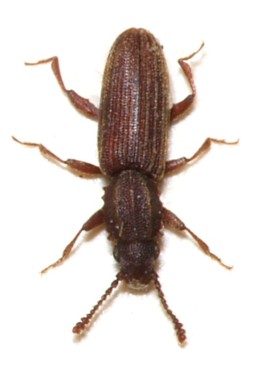
Merchant Grain Beetles
A slender dark brown to black beetle 2.5 – 3mm with jagged edges on the thorax.
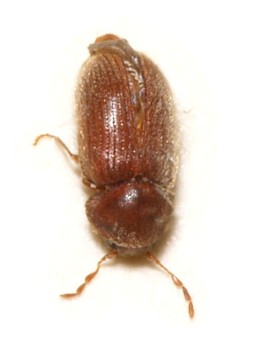
Drugstore Beetles
Approximately 1/10 inch in length, reddish-brown in colour and oval shaped. Hair appears in lines on the insects hard shell (elytra).
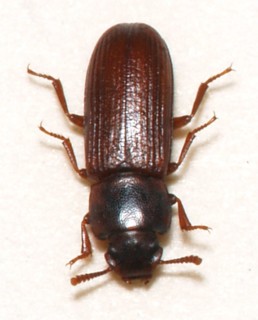
Confused and Red Flour Beetles
Flour beetles are small 3-6mm long and reddish-brown in colour.
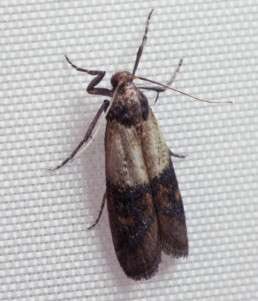
Indian Meal Moths
Adults are 8 – 10mm long, outer half of their wings are dark gray or copper coloured with tan or yellowish-grey upper half of their wings. Larvae are off-white with brown heads.
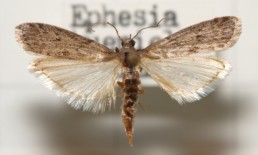
Mediterranean Flour Moths
The adults of this species are 12 mm long with dark zigzag markings across the wings. The larvae are off-white with a darker head and small black spots on the body.
Identify a Pest - Spiders
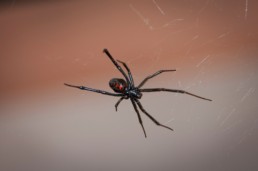
Black Widow Spider
Adult females spiders are black with a bright red hourglass marking on the abdomen. Immature females may have two red dots that have not yet developed into the telltale hourglass marking.
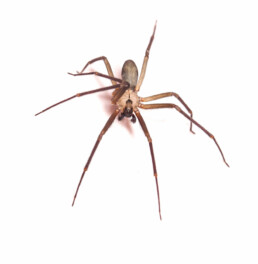
Brown Recluse Spider
Light to medium brown 6 to 20mm with markings on their cephalothorax, with a black line coming from it that looks like a violin with the neck of the violin pointing to the rear of the spider.
Image Attributions

Identify a Pest
Identify a Pest
Identifying a pest can be difficult. Use this page to help you identify a pest.
This page can help you identify many of the common pests, their physical attributes and issues. Of course, if you can’t identify a pest – give us a call!
Identify a Pest - Bedbugs
Bed bugs are nocturnal blood-feeding pests of humans are oval shaped reddish brown insects, 1 – 5 mm (1/16 inches to 3/16 inches) long.
Identify a Pest - Ants
Pavement Ants
An introduced pest from Europe, Pavement ants are 2-4 millimeters long and range from dark brown to black in colour.
Carpenter Ants
Nesting inside our structures, Carpenter ants are large black ants with polymorphic (varying sized) workers. One species in southern Ontario is black with a red thorax. Workers range from 6 – 12 mm and winged swarmers up to 18mm. Queens are rarely seen and can be as large as 20mm long.
Pharaoh Ants
Tiny and almost translucent, Pharaoh ants are yellow or reddish-brown in colour and are very small (2 mm in length).
Identify a Pest - Cockroaches
German Cockroach
The German cockroach is brown with two black horizontal stripes on their pronotum (the shield-like structure partially covering the insects head and thorax) from behind their head to the base of their wings. They are 11 mm to 16 mm in size (adults are ½ inches to 5/8 inches long). Adults are winged. Immature cockroaches do not have wings and are light brown with varying dark brown markings.
Identify a Pest - Fleas
Flea
Mainly pests of pets, Fleas will also take a bite out of humans. Adults are 1 to 4 mm long and are black to reddish-brown in colour. They are flattened laterally to pass easily through the fur of animals.
Identify a Pest - Bees and Wasps
Yellow Jackets
There are 3 species in Southern Ontario with black and yellow bands on a smooth abdomen. Quite often confused with honeybees which are thicker insects with hairy bodies. Yellow jackets are typically 12mm in length.
Bald Faced Hornet
With a very painful sting, Bald Faced Hornets are 13 to 20mm and black with white or bluish markings.
Carpenter Bee
Carpenter bees are thick and robust with a shiny abdomen. They are black or mainly black with yellow or white markings. Commonly confused with Bumble bees which are hairy with larger yellow markings.
Identify a Pest - Pantry Pests
Sawtoothed Grain Beetles
A slender dark brown to black beetle 2.5 – 3mm with jagged edges on the thorax.
Merchant Grain Beetles
A slender dark brown to black beetle 2.5 – 3mm with jagged edges on the thorax.
Drugstore Beetles
Approximately 1/10 inch in length, reddish-brown in colour and oval shaped. Hair appears in lines on the insects hard shell (elytra).
Confused and Red Flour Beetles
Flour beetles are small 3-6mm long and reddish-brown in colour.
Indian Meal Moths
Adults are 8 – 10mm long, outer half of their wings are dark gray or copper coloured with tan or yellowish-grey upper half of their wings. Larvae are off-white with brown heads.
Mediterranean Flour Moths
The adults of this species are 12 mm long with dark zigzag markings across the wings. The larvae are off-white with a darker head and small black spots on the body.
Identify a Pest - Spiders
Black Widow Spider
Adult females spiders are black with a bright red hourglass marking on the abdomen. Immature females may have two red dots that have not yet developed into the telltale hourglass marking.
Brown Recluse Spider
Light to medium brown 6 to 20mm with markings on their cephalothorax, with a black line coming from it that looks like a violin with the neck of the violin pointing to the rear of the spider.
Image Attributions
Fleas
Fleas are small parasitic insects that feed on the blood of pets and humans.
Flea bites cause discomfort and can also transmit parasites or disease to us or our beloved pets. There are over 2500 species of fleas worldwide. The most widespread species in Southern Ontario are cat fleas and dog fleas. However, fleas are not only limited to cats and dogs; they can infect other species as well.
Characteristics of fleas
- Adults are 1 to 4 mm long and are black to reddish-brown in colour.
- A female cat flea can produce up to 2000 eggs in its lifetime.
- Fleas have four life cycles that consist of eggs, larvae, pupa and adults (adults represent only 5% of the flea population).
- Larvae represent the largest proportion of the colony and survive off the host such as pet bedding, couch cushions, cracks in flooring and under baseboards. Larvae can eat a variety of organic matter but are mainly sustained by eating the blood rich feces of the adults.
- It is imperative to treat both the pet and all areas of the home where the pet inhabits since more than ¾ of a flea’s life is spent in areas other than the host.
How Progressive Pest Control Can Help
Don’t let a flea infestation keep you up all night scratching. Call the experts at PROGRESSIVE PEST CONTROL. We are experienced in the safe application of effective products approved by Health Canada. With the use of the right products and the latest methods, we will ensure that your pest problem is efficiently exterminated.
About Progressive
About Progressive Pest Control - Dedicated to helping you and the environment.
With over 20 years of experience, Progressive Pest Control is your local independent expert pest control and pest prevention service, supplier. We specialize in all types of residential and commercial service programs whether it’s a one-time pest service or a regularly scheduled prevention program. We are a fully licensed pest control operation in the province of Ontario.
At Progressive Pest Control, we are committed to providing environmentally responsible and health sensitive pest control solutions at an affordable price.
We will provide safe pest control solutions for your home or business by focusing on an environmentally responsible approach. It is important to us that we solve your pest problems in a way that ensures your home and work environment is a healthy one.
Servicing:
Kitchener, Cambridge, Waterloo, Brantford, Hamilton, Guelph, Simcoe, Woodstock… and all areas in between.
Commericial Services
Commercial Pest Control Services
Progressive Pest Control specializes in providing commercial pest control services with the protection you need for their establishment. We can prevent pests from damaging your business and your reputation. Our experienced technicians can assist with a one-time extermination or develop an environmentally responsible Integrated Pest Management program for many types of facilities.
- Restaurant and Food Services
- Hospitality and Accommodation
- Property Management and Landlords
- Healthcare and Long-term Care
- Warehousing and Distribution
- Retail
- Food Processing and Pharmaceuticals
Pest Control Services for Restaurant, Food Services, and Retail
A quality pest prevention program is crucial in the restaurant and food service industry. Not only can pests transmit disease and destroy inventory, they can also cause serious damage to your reputation.
- Progressive Pest Control offers regular scheduled preventative commercial pest control services
- Free emergency services for contracted services
- Fly management programs
- Detailed documentation
- Washroom hygiene services
- Odour control
Pest Control Services for Hospitality and Accommodation
A damaged reputation due to pest sightings in your rooms or common areas can translate into lost revenue. With social media and bed bug reporting websites, this has become a major concern in the industry. We can fix your bed bug and other pest issues quickly so you can get your rooms back into operation and make you money. As part of our commercial pest control services for hospitality and accommodation treatments, we offer the following:
- Fast effective treatments
- Regular scheduled preventative programs
- Free emergency service for contracted services
- Room inspection services
- Fly management programs
- Washroom hygiene services
- Odour control services
Pest Control Services Property Management and Landlords
Whether you are a commercial or residential property manager, Progressive Pest Control can tailor a comprehensive preventative program or a responsive program of commercial pest control services for your facility.
As part of our property management services, we offer:
- Regularly scheduled preventative programs
- Fast cost-effective in-suite exterminations
- Customized treatment programs
- In-depth documentation
- Full building eradication programs
Pest Control Services Healthcare and Long-term Care
At Progressive Pest Control, we understand the importance of a pest-free environment for the health and comfort of your patients. We excel in safe, effective treatment and preventative commercial pest control services that will not impact the health of those in your care.
Our treatment options include:
- Fast, cost-effective suite treatments
- Fly management programs
- Odour control services
- Detailed documentation
- Safe, regularly scheduled preventative programs
- Free emergency service for contracted services
Pest Control Services for Manufacturing, Warehousing, and Distribution
Progressive Pest Control’s experienced technicians can develop a unique program to meet the commercial pest control service demands for your facility. We will develop a plan that takes your processes, building structure and employee’s health and safety into consideration. We can help by offering:
- Regularly scheduled preventative programs
- Free emergency service for contracted services
- In-depth documentation
- one-time pest eradication.
Pest Control Services for Food and Pharmaceutical Processing
Progressive Pest Control can develop a successful, fully documented program that can stand up to the necessary auditing requirements for your facility. For our food and pharmaceutical customers, we can offer commercial pest control services, including:
- Weekly, bi-weekly or monthly preventative programs
- Customized service and treatments
- Free emergency service for contracted services
- Fly management programs
- Risk assessments
- Washroom hygiene services
- Odour control
Contact Progressive Pest Control for a free no obligation estimate for your facility.
Pantry pests
Pantry Pests
Pantry Pests do not generally carry disease but it can be very unappealing to find them in your kitchen and in the food you’ve been eating. There are a large number of species that infest a variety of products. Some of the most common ones are summarized below.
Sawtoothed Grain Beetles and Merchant Grain Beetles
- A slender dark brown to black beetle 2.5 – 3mm with jagged edges on the thorax
- This beetle lays 40 – 280 eggs in a lifetime that span 6 to 10 months but can live as long as 3 years.
- They live in food stored grains such as cereal and nuts, spices, chocolate, and seeds.
Cigarette and Drugstore Beetles
- Both of these species approximately 1/10 inch in length, reddish-brown in colour and oval shaped
- Adults live 2- 4 weeks and the females lay up to 100 eggs.
- They are good fliers and are often found on window sills as they attempt to make their way outside
- The cigarette beetle eats tobacco seeds, dried flowers, dried fish and leather goods
Indian and Mediterranean Meal Moths
- Adults are 8 – 10mm long, outer half of their wings are dark grey or copper coloured with tan or yellowish-grey upper half of their wings.
- Indian Meal Moths are the most commonly found pests stored in grains.
- Larvae of these pests mainly eat grains, grain products, dried fruits, nuts, cereals and a variety of processed food products.
- An Indian Meal Moth lays 100 – 300 eggs in their lifetime and they are easy to recognize compared to other similar species.
Mediterranean Flour Moths
- The adults of this species are 12 mm long with dark zigzag markings across the wings.
- They have the same diet as Indian Meal Moths and the females eat 120 – 680 eggs in their lifecycle.
Flour Beetles
There are many species of Flour Beetles, however, the most common are the Red Flour Beetle and Confused Flour Beetle.
- Flour beetles are small 3-6mm long and reddish-brown in colour.
- Flour beetles attack stored grains including flour, cereal, nuts, pasta, beans and many other food products.
- Flour beetles are a major pest in the agricultural and food processing industry. They quite often make their way into our homes in the goods we purchase.
How Progressive Pest Control Can Help
The highly-experienced technicians of Progressive Pest Control can assist in your battle with Stored Product moths and beetles. We can help locate the infested product and have effective treatments combined with pheromone traps to resolve your infestation. Contact our knowledgeable staff now for a consultation.
Ants
Ants. You find them on your kitchen counter or workspace.
Nobody likes to see ants in their crawling across their path. With over, 12,000 species world-wide, it’s important to have an accurate identification of this pest.
Carpenter Ants
Common invaders of homes in Southern Ontario. Although their name suggests that they would be an industrious addition to your home, these pests can cause significant damage as they tunnel through wood structures to build their nests. The two dominant species are the Northern Carpenter Ant (black abdomen with reddish thorax and head) and the more common Pennsylvanian Carpenter Ant (completely black). Please visit our Carpenter ant page for more information on how to address infestations.
Pavement Ants
Pavement ants are 2-4 millimeters long and range from dark brown to black in colour. An introduced species from Europe, they have established their colonies across North America. Winged reproductive ants swarm mainly in the spring but can also swarm at other times during the year. Workers will leave a pheromone trail which leads to your home once they find a food source. They then follow this trail straight into your home.
Pharaoh Ants
Pharaoh ants are yellow or reddish-brown in colour and are very small (2 mm in length). They were originally found in tropical locations but have made their way to Canada. They currently thrive in buildings across the Southern Ontario region. These ants proliferate by producing additional queens that leave the original nest with a portion of workers and brood (a collection of eggs, pupa and larvae) to start another colony. A single nest can seed multiple colonies in a building in a short time period.
Elimination of these species can be arduous since multiple colonies can consolidate during a pesticide application to repopulate the building at a later time. Insecticide sprays should be avoided since they usually spread the infestation instead of conquering it.
How Progressive Pest Control Can Help
Get relief from ants and call the experts at Progressive Pest Control. We can help identify the specific species and develop a treatment program that works. We can help with the use of the right products and the latest methods to exterminate your ant infestation for good.
Rats & Mice
Rats & Mice Can Be a Big Problem
Aside from being a nuisance, mice and rats can pose a serious health risk in your home or business. They carry a wide variety of diseases and can cause damage to our food and structures with their gnawing habits.
Are rats & mice dangerous?
Rat and mice infestations should not be left to multiply in your home or business since they can carry several diseases and parasites that can transmit to people or our pets. Rats & mice can carry diseases such as Hantavirus, Meningitis, toxoplasmosis, and parasites such as fleas and ticks. Their teeth continue to grow throughout their life which makes them gnaw constantly to keep their incisors worn down and sharp. Rats & mice can cause major damage to our homes and commercial buildings.
Characteristics of mice
Mice are the most common pest encountered in Southern Ontario. House mice and deer mice live everywhere outside and invade our structures for food and shelter. Mice are opportunistic omnivores that eat insects, fruit, nuts, seeds and virtually everything that is eaten by humans. House mice produce 40 – 100 droppings a day and spoil many more food product than they eat. Their teeth continue to grow throughout their lives which cause them to chew constantly to keep their teeth worn down and sharp.
Why do I have mice?
Mice like to live in and around our structures due to the abundance of food, water, and harbourage. They search out shelter inside as their numbers climb around the exterior of our homes and businesses. A fully grown mouse can squeeze through a 6 to 7mm hole to gain entrance into our structures.
Characteristics of rats
Norway Rats can have litters ranging from 3 – 21 young with up to 12 litters per year. This can lead to an explosive increase in their population over a short period of time. A rat’s teeth continue to grow throughout their lifespan. Their constant gnawing keeps their teeth sharp for chewing their way into your home. Rats live in communities with a strict social structure. If you have one living in your home, then expect that many more are living in the vicinity.
Why do I have rats?
Rats like to live in and around our structures due to the abundance of food, water, and harbourage. They live in large colonies that spread out when they become too large for their immediate area to sustain them. Rats more aggressively invade our homes as temperatures drop outside in the fall. A fully grown rat can squeeze through a 20mm hole to gain entrance into our structures.
How can I prevent rats & mice from entering my home?
Rats & mice are great climbers. Think 3 dimensionally when assessing your home for rodent entry points. Both rats & mice can squeeze through small holes to gain entry into our structures.
- Reduce clutter around the outside of your premises. Clutter provides harborage for families of mice and rats.
- Discourage rodents from living close to your home by trimming back foliage from your structure. Clean up the bottom of shrubs for a clear view of the stems.
- Control the number of food sources available outside your home such as spilled garbage, birdseed, and compost bins.
- Seal off potential entry points such as garage door seals, small openings in building foundation and points where utility lines enter the house.
How Progressive Pest Control Can Help
Call us to remove rats & mice from your home or business. Our professional staff will work quickly to remediate your infestation and set up a program to prevent future infestations. Ask us about our rodent proofing service to reduce the chance of a reinfestation.
Aside from being a nuisance, mice and rats can pose a serious health risk in your home or business. They carry a wide variety of diseases and can cause damage to our food and structures with their gnawing habits.
Cockroaches
Cockroaches are one of the world’s most tenacious creatures.
After decades of dwindling numbers due to the advancement in professional pest control products, they have rebounded with a vengeance! These persistent critters are becoming resistant to commonly used pesticides and are now building up their populations once again. They continue to persevere due to several survival strategies that have evolved over their 300-million-year existence.
There are many species of cockroaches. The most common infester in Canada is the German cockroach.
Characteristics of German Cockroaches
The German cockroach is brown with two black horizontal stripes on the shield-like structure partially covering the insects head and thorax. They are 11 mm to 16 mm in size (adults are 1/2 to 5/8 inches long). Adults are winged although they cannot fly. After mating, females can produce an egg sac every six weeks containing 30 – 48 eggs.
Cockroaches prefer warm, moist environments and like to hide in kitchens, washrooms, and laundry rooms although they can also be detected in all areas of a residence.
What are the signs of a cockroach infestation?
- Cockroach droppings are dark brown or black and cylindrical-shaped (I – 2 mm long).
- Cockroaches shed their skin several times as they mature. The shed skins are usually found close to their hiding-places.
- Oily, musky smell emitted from cockroaches as an aggregation, sex, or danger pheromone.
- Discarded egg sacs (ootheca)
Do cockroaches carry disease?
German cockroaches carry disease-causing organisms on their legs and bodies and can deposit them throughout your home, in your food, on your dishes and utensils. Cockroaches shed their skin as they grow. Their cast skins and excrement can cause allergic reactions and aggravate symptoms of asthma.
How Progressive Pest Control Can Help
Cockroach treatments can be complicated due to the insects ability to tolerate commonly used pesticides. At Progressive Pest Control, our knowledgeable technicians will assess your infestation and customize a treatment plan that suits your needs. If the problem persists, then we will return to your location at no additional cost to you.
Bed Bugs
After a long break from the public eye, bed bugs are back in the spotlight. These pests can be found anywhere that people live or work such as high-end hotels, nursing homes, high-rise apartments, and residential settings. These persistent pests like to travel and can easily hitchhike from location to location on luggage, clothing, and other items. The recent resurgence of bed bugs can be accredited to an increased resistance to traditional pesticides, ineffective pest control practices, the popularity of purchasing second hand goods and more frequent world-wide travel.
Characteristics of Bed bugs
- Size: 1 – 5 mm (1/16 inches to 3/16 inches) long.
- Bed Bugs are oval shaped and reddish brown in colour.
- They feed on blood and can live up to one year on a single feeding.
- They don’t carry disease, but their bites can cause severe allergic reactions. Many people don’t react to their bites at all.
- Bed bugs are mainly nocturnal and live close to their food source – YOU!
- They are highly attracted to heat and carbon dioxide.
- A female will lay 2 – 5 eggs per day – up to 500 in her lifetime.
- A bed bug takes 4 – 5 weeks to grow from an egg to an adult.
Where can Bed bugs be found?
Don’t just throw out your mattress and hope the problem is gone. Bed bugs can be found in many other areas then just your mattress. They live within striking distance of where you sleep which can be up to 20 feet away. They can hide in these areas in the daytime, waiting to ambush you at night:
- Bed frames
- Headboards
- Mattresses and box springs
- Under baseboards and behind window trim
- Near electrical outlets and electronics
- Dressers and night tables
- Behind picture frames
How do I know if I have Bed bugs?
The first indications of an infestation is often the appearance of itchy bites and reddish-brown stains on your bedsheets. Live bed bugs, cast skins and small white eggs (approximately 1mm long) can be found in the seams of the mattress, box spring and headboard. More advanced infestations will expand to other bedroom furniture, curtains, picture frames, and baseboards as well as couches and chairs. If you are unsure, try to identify a pest.
What should I do if I find Bed bugs?
Consider contacting a professional exterminator if you detect Bed bugs in your home or business. If not handled properly, the infestation can spread and become more difficult and expensive to treat. Do not remove infested furniture from the home since they can dislodge and spread to other areas. Do not leave the affected room vacant for long since the Bed bugs will search out a new food source. This can result in a longer treatment process if they find their way into areas such as wall and floor voids.
Chemical free Bed bug treatments
Although newer chemical treatments are very safe and effective at remediating Bed bug infestations, they can be very labour intensive for the resident of the home. The introduction of biological pesticides has provided good options for those concerned with conventional chemical treatments. Biopesticides will often continue to kill bed bugs for up to 3 months which is not provided by other chemical free treatments such as expensive heat treatments. A biopesticide application exterminates the existing population and prevents a reinfestation for up to 3 months.
Aprehend® is a biopesticide which is completely harmless to people and pets. The active ingredient in Aprehend® is a natural fungal disease of insects called Beauveria Bassiana. The Aprehend® treatment is very effective in exterminating Bed bugs from many different settings and often works quicker than conventional treatments.
Progressive Pest Control provides biological, chemical or hybrid treatments to remediate Bed bug infestations. We are happy to evaluate your home or business to determine which option is best for you.
How Progressive Pest Control Can Help
Every Bed bug treatment is different. At Progressive Pest Control, our technicians will customize a treatment program tailored to your specific needs. We use a combination of techniques to reduce the Bed bug population quickly and provide long term protection against reinfestation.